
From Mazury to Ledbury (via Mallorca): Why I Started APMBuild
This isn't a corporate origin story. It's how a kid from the Mazurian Lakes ended up building Passive House retrofits in Herefordshire — through Polish Army engineer reconnaissance, German building sites, a mountain renovation above Valldemossa, and one English client who trusted me enough to bring me to Ledbury.
Where I started — Mazury
I was born in Mazury — the Mazurian Lakes region, Pojezierze Mazurskie, the north-east corner of Poland. It is a quiet country of lakes, forests and small towns, closer to the Lithuanian border than to Warsaw. Long winters, short summers, deep snow, and a building stock that has to take it all without complaint.
I did not grow up in a craft family. My father was a long-distance lorry driver, on the road most of the week. My grandfather was a firefighter. Nobody at the kitchen table talked about U-values or roof pitches. Construction was not the family business.
What I had instead was the cab of my father's truck. In every school break I rode with him across Poland — Mazury to Silesia, the coast to the Tatras, town after town, week after week. I sat in the passenger seat and watched the country go past at the speed of a tired diesel. Most kids my age saw their own village. I saw fifty.
That is where I started reading buildings before I knew I was doing it. Which barns were still standing after fifty winters. Which housing blocks were already failing after ten. Which farmhouses had been patched into something solid; which "modern" extensions had been bolted on and forgotten. Construction was in my head long before any classroom.
Construction school, then 1999 — the army
After general school I went to szkoła budowlana — construction school. First formal trade training. Masonry, basic structures, drawings, materials. The teachers were ex-site men and they taught the way ex-site men teach: do it, do it again, do it properly the third time.
Then in 1999 I joined the Polish Army — engineer reconnaissance (rozpoznanie inżynieryjne). Combat engineer reconnaissance is not what most people picture when they hear "army". The job is to read terrain and structures before anyone else moves through them. Bridges, buildings, ground conditions, obstacles — assess, sequence, plan, then act.
That training shaped how I work today more than any site course has since. Precision under pressure. Read the situation before you cut anything. Plan the sequence before you commit. Never improvise something you could have detailed in advance. The discipline of military engineering still underpins how I run every APMBuild site — quietly, but it is there in every method statement.
Poland, then Germany — my first Passive House
After army service I went back to construction sites — full-time, in Poland. Masonry, timber, joinery, working under foremen who had been doing it for decades. That is where the trade actually gets learned. Not in a classroom, not in an army manual — on a wet site in November with a delivery that is missing half its order.
Then I moved to Bavaria for work. The wages were better, but more importantly the standard was different. My first Passive House project under construction was in Drosendorf — a small village in northern Bavaria. After that I worked on more Passive House sites closer to Munich. By the time I left Germany I had seen the standard built more than once, not in a textbook, but on real sites with real weather and real deadlines.
The shock was not engineering wizardry. There was no exotic equipment, no spaceship technology. The shock was the obsessive care for detail. Airtightness tape on every junction, every penetration, double-checked. Thermal bridges resolved on the drawing before a single block was laid. MVHR commissioning treated as seriously as the structural work. The site agent walked around with a thermal camera the way a site agent in Poland might walk around with a level.
What I understood, watching those Bavarian sites, is that Passive House is not a fancy upgrade. It is what good construction should look like if you take physics seriously. Heat moves through walls whether you respect it or not. The Passive House standard is just the discipline of building as if that were true. That realisation has driven every job I have done since.
Mallorca — and the project that brought me to England
From Germany I moved to Mallorca, and stayed for eight years. Different climate, same craft. People assume Mediterranean construction is easy — warm weather, no frost, what could be hard? In reality the fabric problems are real: overheating, humidity, brutal sun, salt-laden air, and stone walls that breathe in ways nothing in northern Europe does.
In those eight years I worked on the full range — new build houses, swimming pools, renovations, modernisations of existing stone properties. That breadth matters. You learn how a building moves in the Mediterranean. You learn how to detail a pool that holds up to thirty-five degrees one week and four-degree mountain nights the next. You learn that “Mediterranean” covers everything from beach apartments to alpine-style mountain houses, and the fabric has to respond to each one differently.
One project on Mallorca changed everything. I modernised a house above Valldemossa — the mountain village in the Tramuntana range where Chopin spent the winter of 1838 — for an English client. Mountain-top property, demanding site, narrow access, an English owner who valued quality enough to fly out and walk the works himself.
The project finished. The owner was happy. And then he asked me a single question that decided the next decade of my life: "Would you come to Ledbury and build a house for me?"
I said yes.
2013 — Ledbury
I arrived in the UK in 2013 and got straight to work on that client's house in Ledbury — a black-and-white market town in Herefordshire, about thirteen miles east of Hereford. New build, residential, the project I had agreed to over a coffee on a Spanish mountain.
I built it. The client was pleased. I stayed. I brought my family over — wife, children — and we settled in the area. What was supposed to be one project became a country.
For the next eleven years, from 2013 to 2024, I worked on UK construction sites. Main contractor projects. Sub-contractor work for other firms. Retrofit. New build. Extensions. Listed buildings. The full range. Long enough to stop being a visitor and start being someone with an opinion on how UK construction really works.

And what I saw in that time was the gap. Clients paying European-level prices and receiving UK-level fabric performance. Airtightness treated as an afterthought, if it was treated at all. Thermal bridges left wide open at every reveal. "Good enough" accepted as a standard on jobs that should have been built to last a century. Not because the trades were bad — there are excellent UK trades — but because the culture had never demanded better and the supply chain had never made it easy.
Why APMBuild — 2024
After more than a decade on UK sites I knew exactly what was missing. The combination that nobody was offering, anywhere I had looked, was this: PHPP-informed delivery, a direct European supply chain, and a single contractor who actually builds the project — not just consults on it from an office.
There were consultants. There were importers. There were good contractors. There was nobody putting all three under one roof and signing one contract for the whole thing.
In 2024 I founded APMBuild Ltd — Companies House registration 16087373, registered in England and Wales, VAT GB480321319. Based in Hereford, deliberately close to Ledbury where my UK story started, and centrally placed for the border counties and south Wales. The kind of country where the housing stock is old, the heating bills are high, and the appetite for proper retrofit is finally growing.
The model is one contractor end-to-end. Materials sourced directly from European manufacturers I have worked with for years. PHPP-informed specifications driving the fabric strategy. A–Z delivery from design through build to interiors. No fragmented handoffs. No salesperson, then estimator, then site manager you have never met. You ring me. I answer.

What I tell every new client
Whenever someone calls me about a possible project — whether it is an architect with a planning-stage scheme or a homeowner who has just looked at their heating bill and gone quiet — I tend to say more or less the same three things.
First: we are building this for your grandchildren, not for our invoice this quarter. The decisions you make at design stage will sit in this house for fifty years. The walk-on-water energy upgrade you bolt on later because the fabric was wrong will cost more than getting the fabric right at the start. Energy efficiency is not a luxury upgrade — it is just doing building properly, by the physics.
Second: trust your instincts. If a quote feels rushed, the build will be rushed. If a contractor does not want to discuss the airtightness strategy, the airtightness will be wrong. If someone is selling you a price without explaining the spec, the spec is the problem. The cheapest quote is almost never the cheapest project; it is just the quote that has left out the most.
Third: ring me. Not because I am the only person in the UK who can do this — there are excellent retrofit specialists, and on some projects we will refer you to someone better suited — but because the conversation costs nothing and clarifies a lot. We will talk like neighbours, not like vendor and buyer.
If you have a project — whether it is a Victorian terrace that needs to last another century, a new build aiming at Passive House, or just an extension you would like done once and done right — call 07711 266 107 or email pawel@apmbuild.uk. Same day, no script, no pitch deck. Just a conversation about what you actually want, and whether we are the right team to help you get it. You can read more about my background on the about page.
Frequently asked questions
Where did you learn passive house construction?
I first saw a Passive House under construction in Drosendorf, a small village in northern Bavaria, while working in Germany after my Polish Army service. After that I worked on more Passive House sites closer to Munich. Those Bavarian sites introduced me to the obsessive detailing — airtightness, thermal bridges, MVHR — that passive house construction demands. Combined with later PHPP training and more than ten years on UK construction sites since 2013, that is how APMBuild's approach took shape.
What brought you from Poland to the UK?
A single English client. After I renovated a mountain-top house for him above Valldemossa on Mallorca, he asked me to come to Ledbury, Herefordshire and build him a new house. I said yes, arrived in 2013, brought my family over, and have been working in UK construction ever since.
What is your background before construction?
I was born in the Mazurian Lakes region of north-east Poland. My father was a long-distance lorry driver and my grandfather a firefighter — nobody in my family was in the trade. I went to construction school after general school, then served in the Polish Army (engineer reconnaissance) from 1999, before working full-time on construction sites in Poland, Bavaria (including a Passive House in Drosendorf and later sites near Munich) and Mallorca, where I spent eight years on new builds, swimming pools and renovations.
When did you found APMBuild Ltd?
APMBuild Ltd was founded in 2024 and is registered in England and Wales (Companies House 16087373, VAT GB480321319). We are based in Hereford, deliberately close to Ledbury where my UK story started, and we build across Herefordshire, Worcestershire, Gloucestershire, south Shropshire, Monmouthshire, east Powys and the Cardiff area.
How can someone start working with you?
Start with a free 30-minute consultation with me, no obligation. If APMBuild is not the right fit for your project, I will tell you and point you towards someone who is.
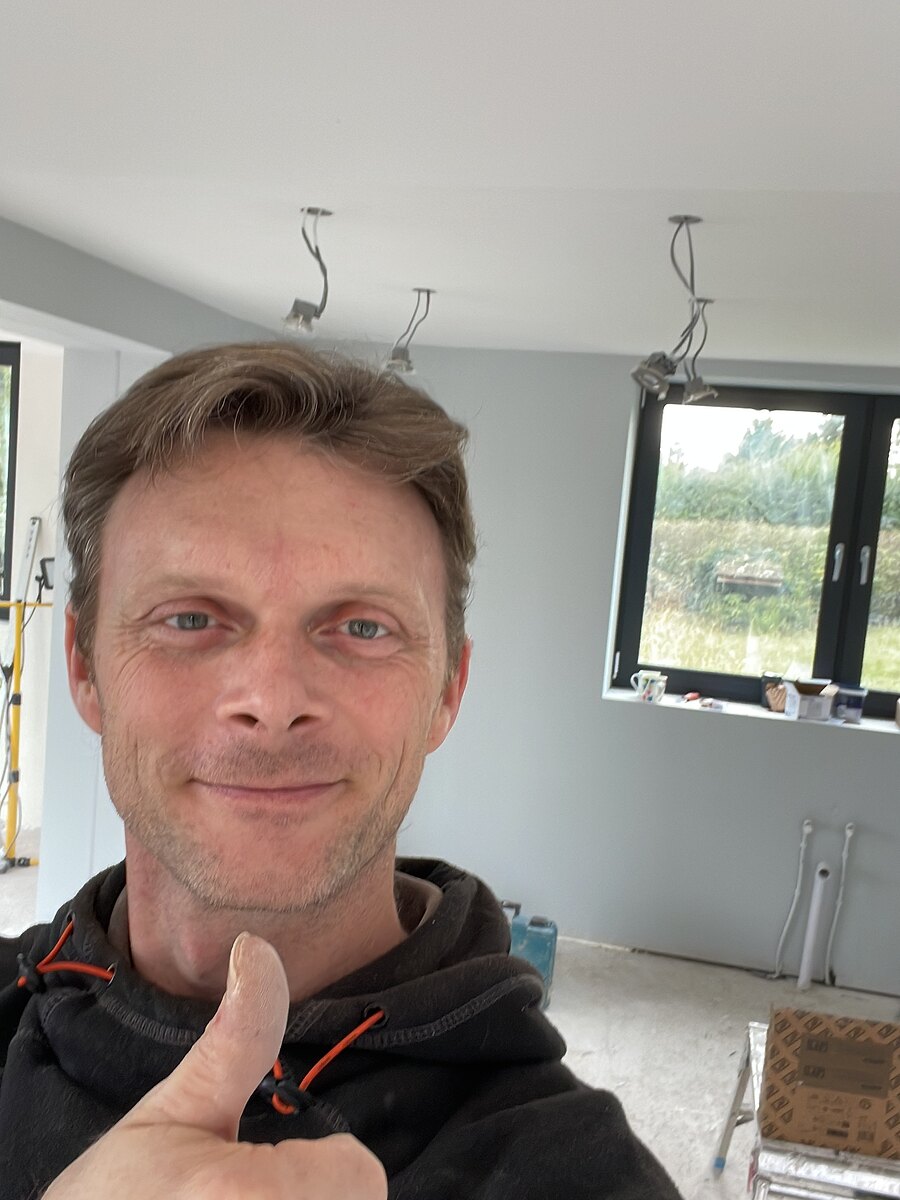
Paweł Okurowski
Paweł Okurowski — born in the Mazurian Lakes region of north-east Poland, trained at construction school, served in the Polish Army's engineer reconnaissance from 1999, learned the trade on sites in Poland, Bavaria (Drosendorf and near Munich) and Mallorca (eight years on new builds, pools and renovations), and moved to Ledbury, Herefordshire in 2013. Founded APMBuild Ltd in 2024. Read more on /about · LinkedIn.