
Timber Frame vs Masonry: The Full Lifecycle View
The sustainability story that doesn't add up — what's actually in the LCA, what's left out, and what UK homeowners should be asking before they're sold a slogan.
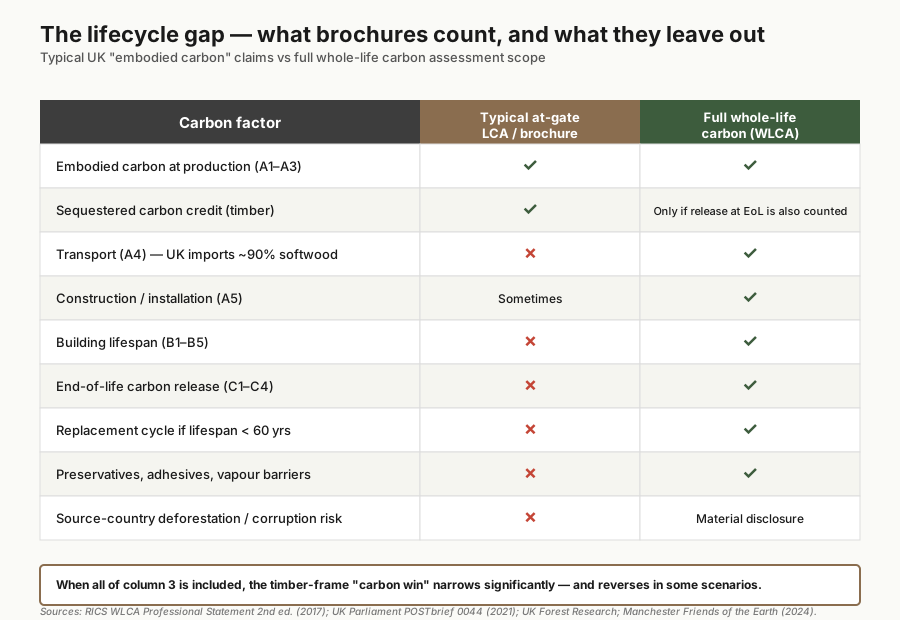
Walk into almost any UK new-build conversation today and timber frame arrives pre-labelled. Renewable. Low embodied carbon. Carbon-sequestering. Future Homes-ready. It's a clean, comfortable story — the kind that fits on a brochure.
After twenty years building across Poland, Germany, Spain (Mallorca) and the UK, I've come to view the way timber frame is sold to British homeowners as something closer to marketing than environmental science. The headline numbers are real, but they're a slice of the picture — and the parts that get left out happen to be the parts that would change the conclusion.
This article walks through what's missing, with the sources cited. I'm not anti-timber. Solid timber from responsibly-managed local sources, used carefully — like a traditional Polish cut-rafter roof on a masonry build — is a legitimate, valuable material. But "renewable" alone doesn't make a material green. Lifecycle does. And by that measure, the timber-frame story is much less settled than the industry's messaging suggests.
The headline that everyone quotes
The "timber frame is greener" claim almost always traces back to embodied carbon comparisons at the point the building is finished. A typical figure, from a comparative LCA of a 100 m² UK dwelling[1]:
| Structural option | Embodied carbon (gate) |
|---|---|
| Steel frame | ~95,000 kg CO₂e |
| Concrete frame | ~38,000 kg CO₂e |
| Timber frame (glulam + CLT) | ~22,000 kg embodied − 15,000 kg sequestered = ~7,000 kg net |
Seven thousand against thirty-eight thousand. The conclusion writes itself.
Except it doesn't, because three things happen after a building is "finished" that this number doesn't account for: it has a lifespan, it has a demolition phase, and it had to be transported there in the first place. Drop any of those three into the calculation and the comparison stops being clean.
What end-of-life does to the maths
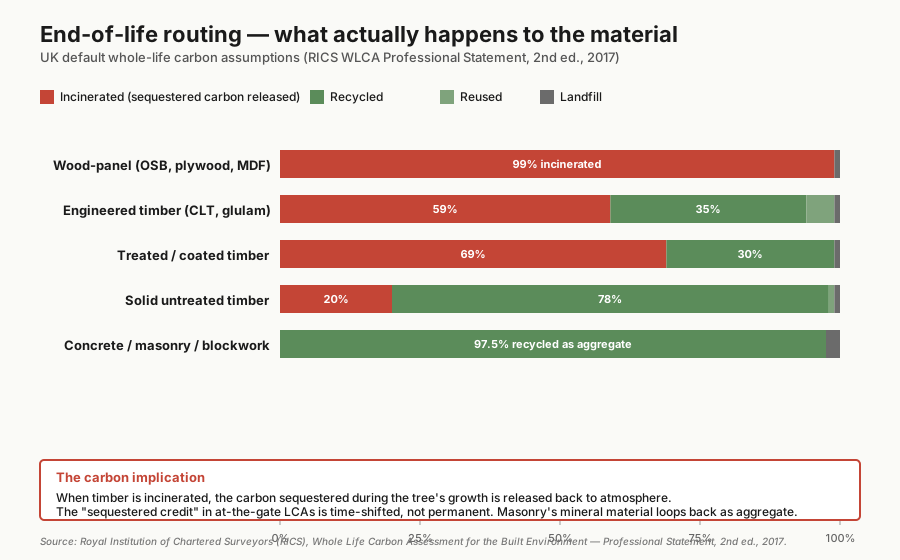
The Royal Institution of Chartered Surveyors publishes the default end-of-life routings used in UK Whole Life Carbon Assessments[2]. These are the numbers any honest LCA should be using:
| Material | Incineration | Recycled | Reused | Landfill |
|---|---|---|---|---|
| Wood-panel (OSB, plywood, MDF) | 99% | 0% | 0% | 1% |
| Engineered timber (CLT, glulam) | 59% | 35% | 5% | 1% |
| Treated / coated timber | 69% | 30% | 0% | 1% |
| Solid untreated timber | 20% | 78% | 1% | 1% |
| Concrete, masonry, blockwork | 0% | 97.5% | 0% | 2.5% |
When timber is incinerated, the carbon sequestered during the tree's growth is released back to atmosphere. The "sequestered credit" in the at-gate LCA is time-shifted, not permanent. Over a 60-year assessment window, most of it comes back.
Masonry's headline embodied carbon is higher at production. But it doesn't burn at end-of-life. Concrete and blockwork get crushed and downcycled — 97.5% of the mineral material returns to the construction loop as aggregate. There's also a quieter footnote: cement absorbs roughly 10–20% of its calcination CO₂ back over a building's lifetime through carbonation[3]. That's not a marketing slogan — it's measurable chemistry that reduces the long-tail carbon of a masonry building while it's standing.
UK Parliament's POSTbrief 2021 on whole-life carbon flagged this gap explicitly and called for end-of-life routing to be included in LCAs[4]. Industry messaging has largely ignored that recommendation.
The lifespan question nobody wants to settle
Most published LCAs use a 60-year assessment period. That choice quietly assumes the building still exists at year 60. For timber frame in the UK, that assumption is contested.
| Position | Source |
|---|---|
| 25–30 years cited for modern UK softwood timber frame | brand-newhomes.co.uk, drawing on insurance-sector commentary; not an industry-wide position[5] |
| 50–100 years with proper moisture management | Pinewood Structures; Homestead Timber Frames (UK timber industry)[6] |
| 100+ years possible | Structural Timber Association[7] |
I'm not claiming one of these is right and the others wrong — they're all sourced and the dispute is genuine. What matters for the carbon question is the implication: if the lower estimate holds for a typical modern UK softwood timber frame, the building gets demolished and rebuilt at least once inside the LCA assessment window. Embodied carbon is incurred twice.
Polish solid masonry construction, with service lives typically cited by manufacturers at 100 years or more for aerated concrete, ceramic block and silicate systems, is built once for the same 60-year window. That figure comes from the manufacturers' own environmental product declarations, and should be read with the same caution as any industry-supplied number — including the ones quoted for timber above. The per-decade embodied carbon load is fundamentally different — and that's before end-of-life sequestration release is factored in.
Where does UK structural timber actually come from?
The UK imports approximately 90% of its structural softwood. Forest Research and Timber Development UK data[8][9]:
- Sweden: 41–45%
- Latvia: 16–17%
- Finland: 14%
- Germany: 5–6%
- Ireland: 6%
- Top five suppliers combined: >90% of UK structural softwood
Transport distances run 1,500–2,500 km. Manchester Friends of the Earth's 2024 briefing put the UK timber footprint in countries flagged as high-risk for corruption or deforestation at 18% of total[10]. UK plywood is 40% from China and 19% from Brazil[8].
Transport carbon for full-truck timber moves at roughly 50–80 kg CO₂e per tonne over a 2,000 km route. For a typical UK structural timber frame package, that's not trivial — and it's rarely included in the "at-the-gate" embodied carbon figure that gets quoted in brochures.
The green-transformation paradox
This is the part of the conversation I keep coming back to after 20 years on building sites — and the part I find hardest to square. It's almost too obvious to mention, which is why nobody mentions it: the "renewable" structural material being sold as the answer to construction's carbon problem is mature trees, cut down. Living, green, carbon-absorbing trees.
In my experience watching this industry from the inside, this is the contradiction that doesn't get spoken out loud.
A 60-year-old softwood pine in a Swedish forest is sequestering carbon at near-peak rate when it's felled. Mature forests are the planet's biggest carbon storehouses, not young ones — confirmed across the peer-reviewed literature[12]. Cut the tree down, ship it 2,000 km, glue it together with phenol-formaldehyde, install it as framing — and the forest now has a multi-decade gap before the replacement seedling reaches anything like the original tree's sequestration rate. In the first decade, a seedling captures roughly 1% of what a mature tree was capturing[13].
This isn't a marginal effect. A peer-reviewed study cited in Mongabay (2019) found that logging operations in the US state of Oregon released 33 million tons of CO₂ in a single year — "almost as much as the world's dirtiest coal plant"[12]. Sweden, Latvia and Finland are doing the same at industrial scale. The UK is the customer.
The "carbon-neutral cycle" of timber assumes three things:
- The forest is replanted — usually yes, but typically with fast-growing monoculture, not the mixed mature ecosystem that was felled
- The new trees reach equivalent maturity — 50 to 100 years for structural softwood species
- The cycle plays out over multi-generational time
A UK homeowner's planning horizon is 30 years. The UK's Net Zero deadline is 2050 — 24 years from now. The "renewable cycle" doesn't operate on either timescale.
My own observation, in plain terms: we talk about a "green transformation" in construction, and the source material is logging mature green trees. The trees that were absorbing CO₂. To make products that, at end of life, will release the absorbed CO₂ back to the atmosphere through incineration (see end-of-life section above).
That's the paradox I keep noticing. It's nowhere in the UK construction industry's sustainability brochures, and I'm not the only person on a building site who's spotted it — just one of few willing to put it in writing.
The chemistry behind "natural" timber
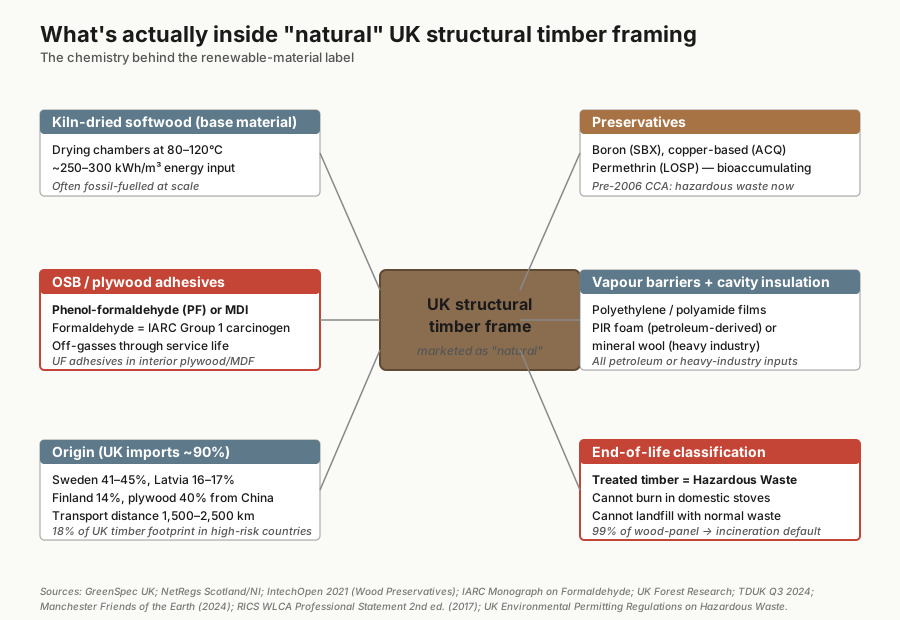
Modern UK structural timber framing is not raw wood. It can't be — raw softwood would fail moisture, biological and fire testing within years. What gets installed contains, by mass, a meaningful fraction of:
| Component | Chemistry |
|---|---|
| Kiln-dried softwood | Drying chambers at 80–120°C, ~250–300 kWh/m³ energy input, often fossil-fuelled |
| Boron preservatives (SBX) | Boron-based fungicide / insecticide |
| Copper-based preservatives | ACQ, copper azole, copper citrate — heavy metals, EU/UK regulated |
| Permethrin (LOSP) | Synthetic pyrethroid insecticide; bioaccumulating |
| Pre-2006 CCA-treated timber | Copper-chromium-arsenic. Banned 2006 for domestic use — still present in older UK buildings, classified as Hazardous Waste at demolition |
| OSB / plywood structural adhesives | Phenol-formaldehyde (PF) or methylene diphenyl diisocyanate (MDI). Formaldehyde is IARC Group 1 carcinogen |
| Interior plywood / MDF adhesives | Urea-formaldehyde — higher VOC emissions, regulated |
| Vapour barriers | Polyethylene or polyamide films — petroleum-derived |
| Cavity insulation in TF buildups | PIR foam (petroleum-derived) or mineral wool |
Sources: GreenSpec UK; NetRegs Scotland/NI; IntechOpen 2021; IARC Monograph on Formaldehyde; TDCA.
Treated timber demolition waste is classified as Hazardous Waste under UK regulations. It cannot be burned in domestic stoves. It cannot go to ordinary landfill. The "natural material" framing collides with that classification fairly hard.
What's actually in Polish masonry
The other side of the comparison rarely gets a fair hearing. Solid masonry — the dominant construction method in Polish new-build housing — isn't the cement-and-steel monolith the UK conversation often imagines. The materials, in practice:
| Element | What it actually is |
|---|---|
| Aerated concrete blocks (AAC) | Produced from a siliceous component — finely ground silica sand or fly ash depending on the plant — with cement and lime as the binders, plus gypsum and a small quantity of aluminium powder as the foaming agent. Both sand-based and fly-ash-based processes are used in Poland. Where fly ash is used it diverts a power-station combustion residue from disposal, but this varies by manufacturer and should be checked against the product's EPD rather than assumed. |
| Ceramic blocks | Local clay, fired in regional kilns, typically transported <500 km within Poland. Virtually unlimited raw material. |
| Silicate / sand-lime blocks | Sand + lime + steam-cured. No firing energy. |
| Cement (Portland) | High carbon at production. Absorbs 10–20% of calcination CO₂ back via carbonation over the building life. |
| Reinforcing steel | <1% of construction volume; 100% recyclable. |
| Timber in roof | Polish-grown FSC/PEFC option; typically 10–15% of structural mass, versus the frame itself in timber-frame construction. |
Service life: manufacturer-declared at 100 years or more on standard maintenance. End-of-life: 97.5% recycled as aggregate under the RICS default routing. Indoor air quality: no formaldehyde off-gassing from the structural elements themselves, though adhesives, finishes and insulation in any build-up need assessing separately. Hazardous waste at demolition: none arising from the masonry itself.
One thing I should say plainly, because the same argument applies to me. I have just spent several paragraphs pointing out that transport carbon is missing from the timber frame story. Polish masonry travels roughly 1,300 to 1,600 kilometres to reach a site in Herefordshire — the same order of distance as Baltic and Scandinavian softwood — and masonry is several times denser, so the tonne-kilometres per building are higher, not lower. I do not have the figures to say where the net balance lands, and I would not trust anyone who claimed to without them. But it would be dishonest to raise transport as a cost against one material and quietly leave it out of the other.
None of this means masonry is "perfect." Production carbon is genuinely higher at the gate. But the gate is not the building.
The thermal mass blind spot
There's a parameter the UK timber-frame conversation rarely mentions, and Building Regulations now formally recognise it. Approved Document O — overheating mitigation — was introduced in 2022 in response to evidence of overheating in new UK homes, with lightweight construction and single-aspect south-facing flats among the archetypes most often identified[11]. Its reach is narrower than most people assume — it applies to new residential buildings only, so the extension or conservatory bolted onto an existing house is not assessed at all. We set out what that means for the homes going up right now in We Are Building the Next Retrofit Programme. And for the practical side — what Germany requires that England does not, and what to do about a room that is already too hot — see How to Stop a House Overheating, which also explains why Germany builds a higher share of its homes in timber than England does without a summer problem.
| Construction | Approximate thermal mass |
|---|---|
| Polish solid masonry (typical) | 300–450 kJ/m²·K of floor area |
| UK cavity wall (block + brick) | 200–300 kJ/m²·K |
| UK timber frame | 50–80 kJ/m²·K |
UK timber frame carries roughly four to six times less thermal mass than Polish solid masonry, and three to four times less than a UK cavity wall — and correspondingly less ability to buffer summer heat. As UK summers warm, this matters more, not less. We covered this in detail in The Thermos Syndrome.
What the UK construction conversation doesn't include
Most of the above is in the technical literature. None of it is secret. What's striking is how little of it makes it into the homeowner-facing conversation about "sustainable construction." The dominant industry messaging compresses to "timber = green" and stops there.
Critical voices exist in the UK but rarely break through:
- UK Parliament POSTbrief 2021 (POST-PB-0044) on whole-life carbon[4]
- RICS Professional Statement on Whole Life Carbon Assessment, 2nd ed.[2]
- Manchester Friends of the Earth on UK timber sourcing[10]
- Insurance Choice UK and brand-newhomes.co.uk on real-world timber frame lifespan[5]
This is the gap that I think APMBuild's job is to fill — not by claiming masonry is the answer to every question, but by helping homeowners see the whole picture before they're sold a slogan.
None of this means "don't use timber"
I want to be careful here. Timber, used well, is one of the best construction materials we have. A traditional cut-rafter roof in C24 timber on a Polish masonry build is an excellent system. Solid floors with timber finishes. Timber cladding from local sources. Wood-fibre insulation. Each of those is a sound material choice with a fair lifecycle case.
What I'm objecting to is the framing: the idea that "timber frame = sustainable" as a blanket conclusion. The reasoning behind that framing rests on a partial LCA that omits transport, lifespan and end-of-life. Add those back in honestly and the comparison becomes a trade-off, not a verdict.
The questions a UK homeowner should ask
If you're being sold a timber frame home on environmental grounds, the questions worth asking are:
- Where does the structural timber actually come from? Sweden? Latvia? China for plywood? What's the certification scheme, and what's the country's risk rating for corruption and deforestation?
- What's the design lifespan, and what's it based on? Industry estimate or insurance estimate?
- What chemistry is in the structural components? Preservatives, adhesives, vapour barriers — all of it.
- Has the LCA included end-of-life routing? Or does it stop at the gate?
- Has transport carbon been included for the structural materials, or only operational energy?
- What's the building's thermal mass, and how is overheating being mitigated under Approved Document O?
Any builder confident in their sustainability story will answer those without flinching. If the answers get vague, that's the answer.
Where APMBuild sits
One thing worth stating plainly, since this article compares two materials: our supply chain is not tied to either. Poland is now Europe's largest MDF producer and, alongside Germany and Romania, holds one of the largest OSB production capacities in Europe, and we can source timber, engineered wood and wood-derived products through the same European supply chain we use for masonry. We have no commercial interest in which material you choose — only in whether the whole-life question gets asked before you choose it.
We build to UK Building Regulations using a direct European supply chain — established European masonry systems when the project calls for them, traditional cut-rafter roofs where the geometry suits, and timber used carefully where it adds value rather than as a blanket "eco" choice. We're Passive House-trained, work mainly across Herefordshire, Powys, Worcestershire and Wales, and our default is to walk a client through the full lifecycle picture before specifying anything.
Planning a new build or deep retrofit?
If you want a builder who won't sell you a slogan, get in touch for a free 30-minute consultation. Call 07711 266 107 or email pawel@apmbuild.uk.
Book a consultationReferences
- Comparative LCA figures as cited in a secondary literature review on whole-life carbon of UK residential construction, 2023. The underlying primary assessment has not been traced; the figures should be treated as indicative rather than authoritative.
- Royal Institution of Chartered Surveyors (RICS). Whole Life Carbon Assessment for the Built Environment — Professional Statement, 2nd ed. RICS, September 2023; in effect from 1 July 2024.
- Peer-reviewed literature on cement carbonation, including Xi, F. et al. (2016), Substantial global carbon uptake by cement carbonation, Nature Geoscience 9, 880–883. nature.com
- UK Parliament. POSTbrief 0044: Reducing the whole life carbon of buildings. Parliamentary Office of Science and Technology, 2021.
- brand-newhomes.co.uk; Insurance Choice UK commentary on modern UK softwood timber frame lifespan. Not a formal industry position, and disputed by the timber sector — see references 6 and 7.
- Pinewood Structures; Homestead Timber Frames technical literature.
- Structural Timber Association, UK industry position on timber frame service life.
- UK Forest Research, Forestry Statistics (annual, 2018–2024).
- Timber Development UK (TDUK), Q3 2024 market data; UK softwood import price tracking.
- Manchester Friends of the Earth, UK Timber Footprint Briefing, 2024.
- UK Government, Approved Document O: Overheating, 2021 edition, in force 15 June 2022. GOV.UK.
- Mongabay News, "Tall and old or dense and young: Which kind of forest is better for the climate?" (May 2019), referencing peer-reviewed forest carbon research and the Oregon logging emissions study. news.mongabay.com
- National Council for Air and Stream Improvement (NCASI), Forest Carbon Research; with corroborating data from Harvard University research on tree-age sequestration rates.
- PARP (Polska Agencja Rozwoju Przedsiębiorczości), Construction and Finishing Materials Sector in Poland 2024.
- Competition and Markets Authority. Green Claims Code: Making environmental claims on goods and services. GOV.UK, 2021.
This article presents the author's professional view, supported by published sources. It is not a substitute for project-specific lifecycle assessment by a qualified assessor. Where environmental claims are made by any builder, ask for the underlying evidence — that is your right under the CMA Green Claims Code and DMCC Act 2024.
Frequently asked questions
Is timber frame really more sustainable than masonry?
The headline claim rests on at-gate embodied carbon, where timber frame outperforms steel and concrete. However, full whole-life carbon assessments must include transport, building lifespan, end-of-life routing and chemistry. When all of these are included, the gap narrows significantly and in some scenarios reverses.
How long does a UK softwood timber frame last?
Sources disagree. UK insurance industry consensus cites 25 to 30 years for typical UK softwood timber frame construction. UK timber industry sources cite 50 to 100 years with proper moisture management, and the Structural Timber Association cites 100+ years possible. Honest content acknowledges this dispute.
What happens to timber framing at end of life?
According to the RICS Whole Life Carbon Assessment Professional Statement, 99% of UK wood-panel products (OSB, plywood, MDF) and 59% of engineered timber (CLT, glulam) are routed to incineration as the default assumption in the absence of project-specific data. When timber is incinerated, the sequestered carbon is released back to atmosphere. Concrete, masonry and blockwork are 97.5% recycled as aggregate.
Where does UK structural timber come from?
The UK imports approximately 90% of its structural softwood. Top suppliers are Sweden (41–45%), Latvia (16–17%), Finland (14%), Germany (5–6%) and Ireland (6%). Plywood is 40% from China and 19% from Brazil. Manchester Friends of the Earth (2024) reports that 18% of the UK timber footprint is sourced from countries flagged as high-risk for corruption or deforestation.
Is treated timber considered hazardous waste in the UK?
Yes. Under UK Environmental Permitting Regulations, treated timber demolition waste is classified as Hazardous Waste. It cannot be burned in domestic stoves and cannot go to ordinary landfill. Pre-2006 CCA-treated timber (copper-chromium-arsenic) is still present in older UK buildings and requires specialist disposal at demolition.
Paweł Okurowski
Director & Founder, APMBuild Ltd. Passive House-trained builder (Level 2 Passive House course at AZB Wrocław, a PHI-accredited training body, January 2023) with 20+ years of European construction experience across Poland, Germany, Spain (Mallorca) and the UK. Read more about Paweł ·LinkedIn.